
Global VC. Aviscenna Syukri on what Pegasus Tech Ventures looks for in startups

Pegasus Tech Ventures manages more than 40 funds and invests in startups around the world. Aviscenna Syukri, an investor at the firm, discusses its investment strategy, the potential of Central Asia’s startup ecosystem, the growing focus on robotics and artificial intelligence, and what startups need to attract international investors.
Aviscenna Syukri, city — Jakarta, SEA Investor, LinkedIn
About Pegasus Tech Ventures
I am an investor at Pegasus Tech Ventures, a venture capital firm based in Silicon Valley, San Francisco, United States.
We started investing in technology companies in Silicon Valley in 2011. In 2013, we expanded our investments to Southeast Asia, East Asia, and the rest of the world. At that time, we managed 10 funds. Now, we have more than 40 funds. Some of these funds are backed by multinational corporations from East Asia, North America, and Southeast Asia.
At our core, we are a venture capital service company. This means that we work with multinational corporations to help them innovate. Sometimes, large corporations are too structurally rigid and do not have the resources or expertise to solve problems within their business units.
For example, a company might have a problem with certain materials or processes. We can help by connecting it with a startup. This is a lower-impact approach for a large corporation because establishing a new business unit requires a lot of resources. We take some of that burden off the corporation and put it on the startup.
We can either identify a specific problem and find a startup that can solve it, or scout startups in a particular geography and see whether their solutions can be applied to multinational corporations such as Aisin or Niterra. For example, a company might need a ceramic solution or another application for ceramic products, and we can help find a suitable startup.
On investments
A couple of years after the COVID-19 pandemic began, we also launched our pre-IPO fund. It targets companies that are approaching an exit. We provide larger investments and support companies as they move closer to an exit.
From an investment standpoint, we do a bit of everything, but our core business is still corporate venture capital.
Our portfolio currently includes more than 200 startups. Every month, we review at least 10 to 20 startups and usually invest in one or two companies. We continue deploying capital every month and work with our corporate limited partners to make sure that startups have the right products for their needs. We also carry out our fiduciary responsibilities to ensure that all the necessary aspects are covered.
Our investment approach varies depending on the region. In developing markets such as Southeast Asia, we tend to be more conservative. Initially, we may write larger checks, but later, as momentum in a region starts to slow down, we reduce the check size to de-risk the investment.
In established markets such as North America and Europe, we tend to invest between $1 million and $20 million. We also look at who is on the cap table because sometimes we want to see strong investors from the industry who have skin in the game in that particular sector.
When we first look at a startup, the key question is whether it is solving a real problem or simply creating a feature. The second question is whether the solution is applicable to the market or industry the company is trying to serve.
The third factor is how driven the founder is. At the core of venture capital, especially at the earliest stages, you are mostly betting on the team. Team quality is key. If you watched the fireside chat earlier, probably every speaker mentioned the importance of the team.
You cannot always bet on the product, but you can bet on the team because companies can pivot. I have seen many companies in my portfolio pivot, and that is okay as long as the team has the expertise and knows how to navigate the process.
We also look at the syndicate of investors on the term sheet because the other investors involved in a deal can be an important factor in our decision.
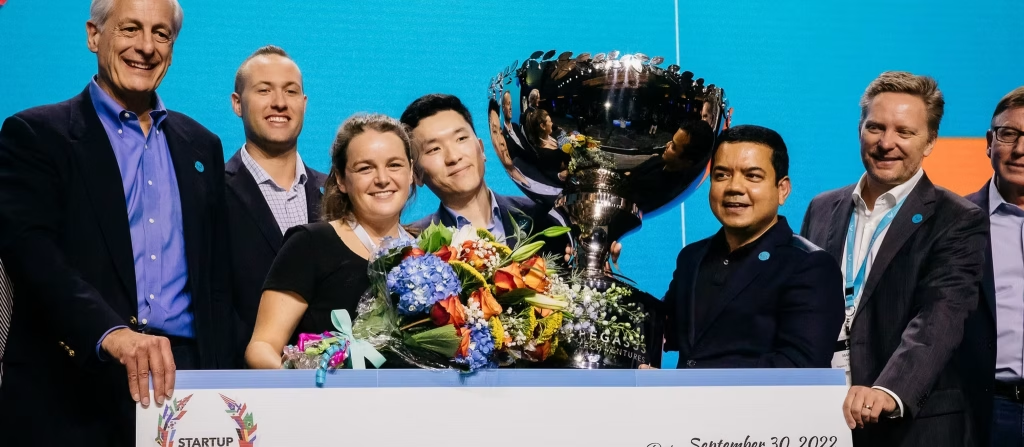
On Central Asia’s startup ecosystem
In terms of the regions I am actively looking at, Southeast Asia and South Asia are my core markets. I also look at North America, Europe, and Eastern Europe, particularly because we are paying more attention to the defense sector.
Personally, I look at these markets quite often. In the long run, I believe that some of the current conflicts will de-escalate, and military technologies and hardware may eventually find civilian applications, as happened after World War II.
As for Central Asia, I think it is one of the fastest-growing regions compared with other markets. In some respects, Africa may be 10 to 15 years behind Central Asia. The government and bureaucracy here are also somewhat more straightforward to navigate.
Africa is a completely different ball game because West Africa and Central Africa are very different markets.
Going back to Central Asia, it is an appealing market, even though there are some regional tensions and ongoing conflicts in the southern part of the broader region, as well as some civil unrest in Kazakhstan.
Nevertheless, there is a real opportunity in the long run. There is a large population that is willing to adopt new technologies and become early adopters. Central Asia is an interesting market, and I think it will be one of the key destinations for venture and equity investment in the foreseeable future.
I think more funds should look at the region. Countries and companies such as BYD, as well as investors from the Gulf states, are looking for places to deploy their capital.

Investor’s advice
For Central Asian startups that want to attract international investors, having a broader perspective can make them much more appealing. Their solutions should be applicable beyond a single country or industry.
For example, consider a robotics company that was developed in the United States and later opened an office in Japan. It recognized the opportunities in another market and expanded its presence there. Having a solution that can be applied in other countries is a plus. Startups should also consider how their technologies can serve different industries and applications.
One of the most common mistakes founders make when pitching to investors is not simplifying their ideas enough for people to understand the core problem they are solving. Sometimes, an idea is too complex to communicate effectively to a jury. Breaking it down into simpler concepts and using analogies or plain language can make it much easier to understand.
Many founders also focus too much on TAM, SAM, and SOM. However, the key question is who their paying customers are and who their next paying customers will be. At the end of the day, paying customers speak for themselves, and unit economics matter more. Founders should explain their unit economics and core business model clearly so that investors can understand where the company makes money, what its margins are, and how its business could develop over the next three to five years.
Founders should also identify where their company stands in the market. Once they understand their position, they can identify competitors and determine how to move forward. It is important to understand the competitive landscape and know who is operating in each area.
Building strong partnerships is another way to attract investors. For example, if you are working in the medical sector, partner with large medical facilities, pharmaceutical companies, or medical suppliers. Attracting recognized names in your industry can help you gain credibility and improve your chances of attracting major investors. The more credibility you build for your brand, the more attractive your company will become to investors.
Plans
In terms of sectors, we focused on artificial intelligence in 2025. In 2026, we are looking more towards robotics.
There is a strong need for robotics, not so much from a consumer standpoint, such as Tesla’s Optimus, but more for industrial applications.
In the United States, there is currently a shift towards revitalizing industry and addressing labor shortages. We see automation and robotics as technologies that can help accelerate this process. There is also much more focus on the entire robotics value chain, including artificial intelligence, software development, control systems, motors, and other robotic components.
The majority of the cost of a robot comes from its servos or motors, so we look at those areas as well. Different industries also have specific requirements for accuracy.
We are interested in precision automation solutions, including software and hardware. We look at actuators, such as robotic fingers and arms, because different engineering applications have different requirements. We also occasionally look at materials science, including next-generation graphene and lithium technologies.